
Jewelry Color Matching: How Manufacturers Maintain Consistent Finishes
Jewelry Color Matching: How Manufacturers Maintain Consistent Finishes
How Jewelry Plating Thickness Affects Wear Resistance
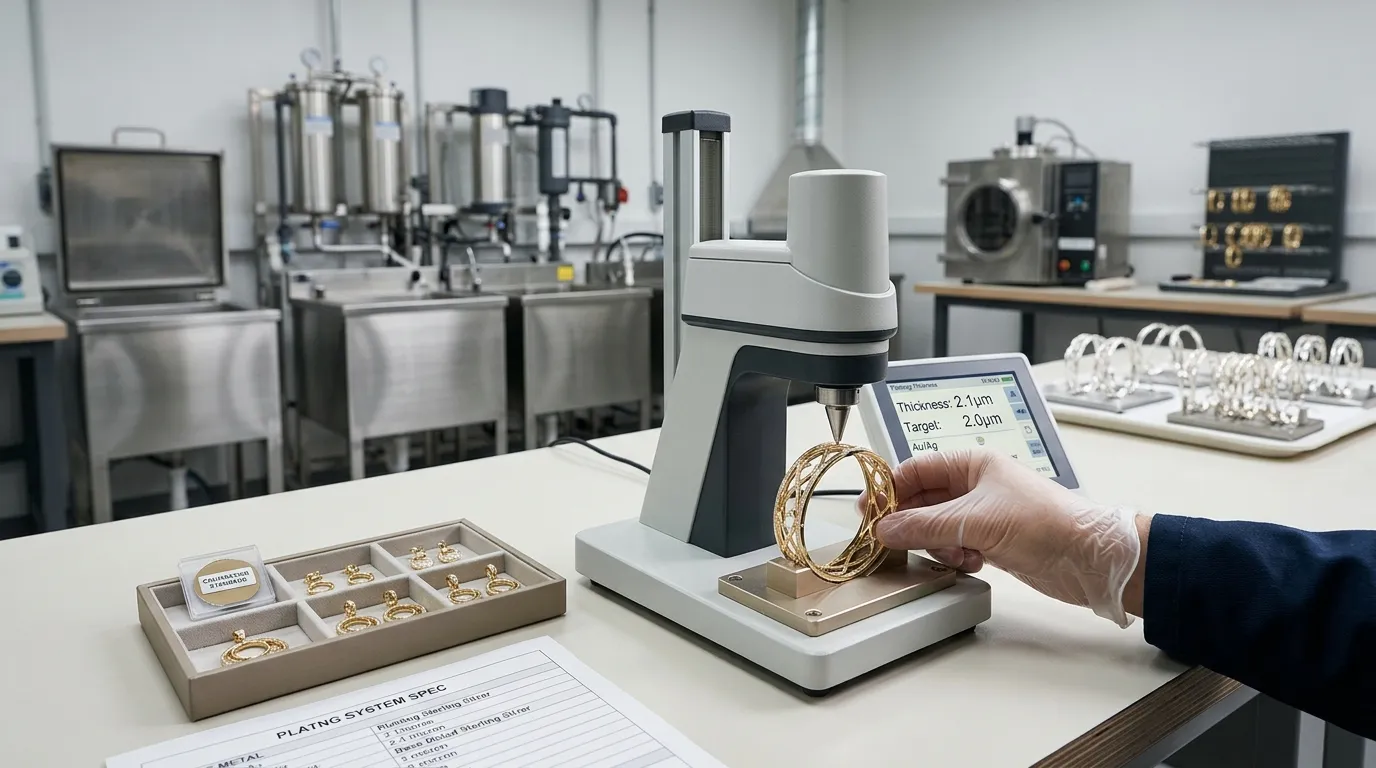
If you are buying gold-plated jewelry for your brand, one of the first questions you may ask is:
“How thick should the plating be if I want it to last?”
The answer is not simply “the thicker, the better.”
Plating thickness matters because a thicker layer generally provides more material to wear through. But actual wear resistance also depends on the base metal, surface preparation, underlayers, plating process, product geometry, friction and how the jewelry is used.
For you as a B2B buyer, this means the right question is not:
“What is the highest plating thickness?”
It is:
“What plating specification matches how my customers will actually use this product?”
At SSJew, we discuss plating thickness together with the entire plating system before production rather than treating μm as an isolated number.
What Does Plating Thickness Actually Mean?
Jewelry plating thickness is normally measured in micrometers (μm).
1 μm = 0.001 mm
So:
Plating thickness
Equivalent
0.1 μm
0.0001 mm
0.5 μm
0.0005 mm
1.0 μm
0.001 mm
2.5 μm
0.0025 mm
5.0 μm
0.005 mm
The difference may look extremely small, but 1.0 μm is 10 times the nominal thickness of 0.1 μm.
ASTM B488, a specification for electrodeposited gold coatings, includes minimum thickness classes from 0.25 μm through 5.0 μm and requires thickness to be specified in micrometers.
For jewelry purchasing, this gives you an important lesson:
“Gold plated” is not a sufficient technical specification.
Does Thicker Plating Always Mean Better Wear Resistance?
Generally, a thicker coating provides more plated material that can be worn away before the underlying material becomes exposed.
But thickness alone does not determine durability.
Imagine two necklaces:
Necklace A
-
Brass base
-
0.5 μm gold
-
High polish
Necklace B
-
Brass base
-
1.0 μm gold
-
High polish
Necklace B has twice the nominal gold-layer thickness.
However, if the surface preparation or adhesion of B is poor, increasing thickness does not automatically solve the problem.
This is why ASTM B488 addresses not only thickness but also substrate condition, coating characteristics and performance requirements.
For you, plating thickness should therefore be viewed as one part of a complete wear-resistance system.
How Different Thickness Levels Affect Wear
As a practical purchasing reference, you may encounter these specifications:
Plating thickness
Typical positioning
Wear consideration
0.1–0.3 μm
Very light decorative finish
Limited wear reserve
0.5 μm
Entry / mid-level plated jewelry
Better than flash-level coatings, but friction still matters
1.0 μm
Higher wear specification
More coating material available before exposure
2.0–2.5 μm
Heavy/premium specification
Suitable for products where greater wear resistance is important
5.0 μm
Very thick coating
Specialized/premium applications
These are planning ranges rather than guaranteed wear-life categories.
For example, a ring worn every day can experience significantly more friction than an earring worn occasionally.
So we would not tell you:
“0.5 μm always lasts six months.”
That would be an unreliable manufacturing claim.
Instead, we look at the product + thickness + usage + plating system together.
Why Rings and Bracelets Need More Attention
Not all jewelry experiences the same amount of wear.
Rings
Rings frequently contact:
-
Fingers
-
Tables
-
Handles
-
Other jewelry
-
Water
-
Cleaning products
The outer surface can experience repeated mechanical friction.
If your collection includes everyday rings, plating thickness deserves more attention than it might for low-contact products.
Bracelets
Bracelets also experience frequent movement and contact with:
-
Skin
-
Clothing
-
Desks
-
Bags
-
Other accessories
The clasp and edges can become particularly important wear areas.
Earrings and Pendants
Earrings and pendants typically experience less continuous mechanical contact than rings.
That does not mean they cannot wear.
But their wear profile may allow a different plating specification depending on how the product is positioned.
This is why we prefer to discuss plating requirements by product type, rather than giving one thickness recommendation for your entire collection.
4 Factors That Affect Wear Resistance Besides Thickness
1. Base Metal
The substrate directly underneath the plating matters.
Common jewelry bases include:
-
Brass
-
Copper
-
925 Sterling Silver
-
Stainless Steel
The base material affects surface preparation, adhesion and how the finished coating behaves.
For example, plating onto a properly prepared smooth surface is very different from plating over a rough or defective surface.
2. Underlayers
A plated jewelry piece may contain multiple layers rather than simply:
Base metal → Gold
Depending on the product, the system may include:
Base metal → Barrier/underlayer → Gold
Underlayers can help address issues such as:
-
Surface compatibility
-
Diffusion
-
Adhesion
-
Appearance
-
Corrosion protection
ASTM B488 specifically recognizes underplating and notes that the underplate can be important to the performance of the final gold coating.
For you as a buyer, this is another reason not to compare suppliers based only on the quoted μm number.
3. Surface Preparation
A thicker coating cannot completely compensate for a poor surface.
Before plating, the jewelry surface may require:
-
Cleaning
-
Polishing
-
Degreasing
-
Activation
-
Surface preparation
Scratches, pits, roughness and other substrate defects can affect the appearance and performance of the final coating. ASTM B488 specifically identifies such substrate defects as factors that can adversely affect coating performance.
At SSJew, we therefore treat polishing and surface preparation as part of the plating process—not as a separate cosmetic step.
4. Product Geometry
Plating thickness is not necessarily perfectly uniform across every part of a jewelry piece.
Corners, edges, recesses, holes and complicated geometries can make thickness control more difficult.
ASTM B488 notes that thickness variation is inherent in electroplating processes and that certain difficult surfaces may require special plating arrangements.
This matters when your design contains:
-
Sharp edges
-
Deep grooves
-
Small holes
-
Intricate textures
-
Recessed areas
-
Multiple components
A flat test area does not necessarily represent every surface of a complex jewelry design.
What Should You Specify as a B2B Buyer?
If wear resistance matters to your collection, do not write:
Gold plated
Instead, define the production requirements.
Your Plating Specification Should Include
1. Plating metal
18K Yellow Gold
2. Thickness
0.5 μm target
or:
1.0 μm minimum
3. Base metal
Brass
4. Surface finish
High polish
5. Reference color
Approved production sample
6. Product usage
Everyday ring
7. QC requirement
Verify plating thickness according to agreed inspection method
This gives us a much clearer manufacturing target.
Target Thickness vs Minimum Thickness
This is a small wording difference that can have a big effect on your purchase order.
0.5 μm Target
This means:
Aim for approximately 0.5 μm according to the agreed production specification.
0.5 μm Minimum
This means:
The measured thickness should not fall below 0.5 μm on the defined significant surfaces.
These are different requirements.
ASTM B488 uses minimum coating thickness requirements and states that the specified thickness must be met throughout significant surfaces.
If plating thickness is commercially important to you, tell your manufacturer which requirement you actually want.
How We Approach Wear Resistance at SSJew
At SSJew, we do not start with:
“How many microns do you want?”
We first want to understand your product.
We Look at the Product
We consider whether you are making:
-
Rings
-
Bracelets
-
Necklaces
-
Earrings
-
Pendants
-
Chains
A ring designed for daily wear has a different wear profile from an occasional-wear pendant.
We Review the Material
We look at:
Base metal → surface preparation → plating structure → final finish
This helps us identify whether your requested plating specification is appropriate for the design.
We Use the Sample as a Reference
Your approved sample gives us a physical reference for:
-
Color
-
Finish
-
Appearance
-
Construction
The written specification then gives production a measurable reference for the plating requirement.
We Clarify QC Before Bulk Production
If plating thickness is a critical requirement, the inspection method should be agreed before production.
Visual inspection can evaluate appearance, but visual inspection alone cannot reliably establish a plating thickness in μm.
Thickness verification may require appropriate measurement equipment and a defined sampling method.
A Practical Example for Your Jewelry Order
Suppose you are developing a 3,000-piece brass necklace.
Instead of:
Brass necklace, 18K gold plated
your production specification could be:
Specification
Requirement
Base metal
Brass
Plating
18K yellow gold
Thickness
0.5 μm target
Surface
High polish
Color
Approved sample
Product use
Everyday necklace
Quantity
3,000 pcs
QC
Agreed plating verification
If you need greater wear resistance, you could instead discuss:
1.0 μm target
or a thicker specification based on the product's positioning and expected use.
The correct answer is not always the most expensive option.
The goal is to choose a specification that matches your product promise and customer usage.