
Jewelry Material Specifications: What to Include in a Manufacturing Order
Jewelry Material Specifications: What to Include in a Manufacturing Order
Why Material Specifications Matter in a Jewelry Manufacturing Order
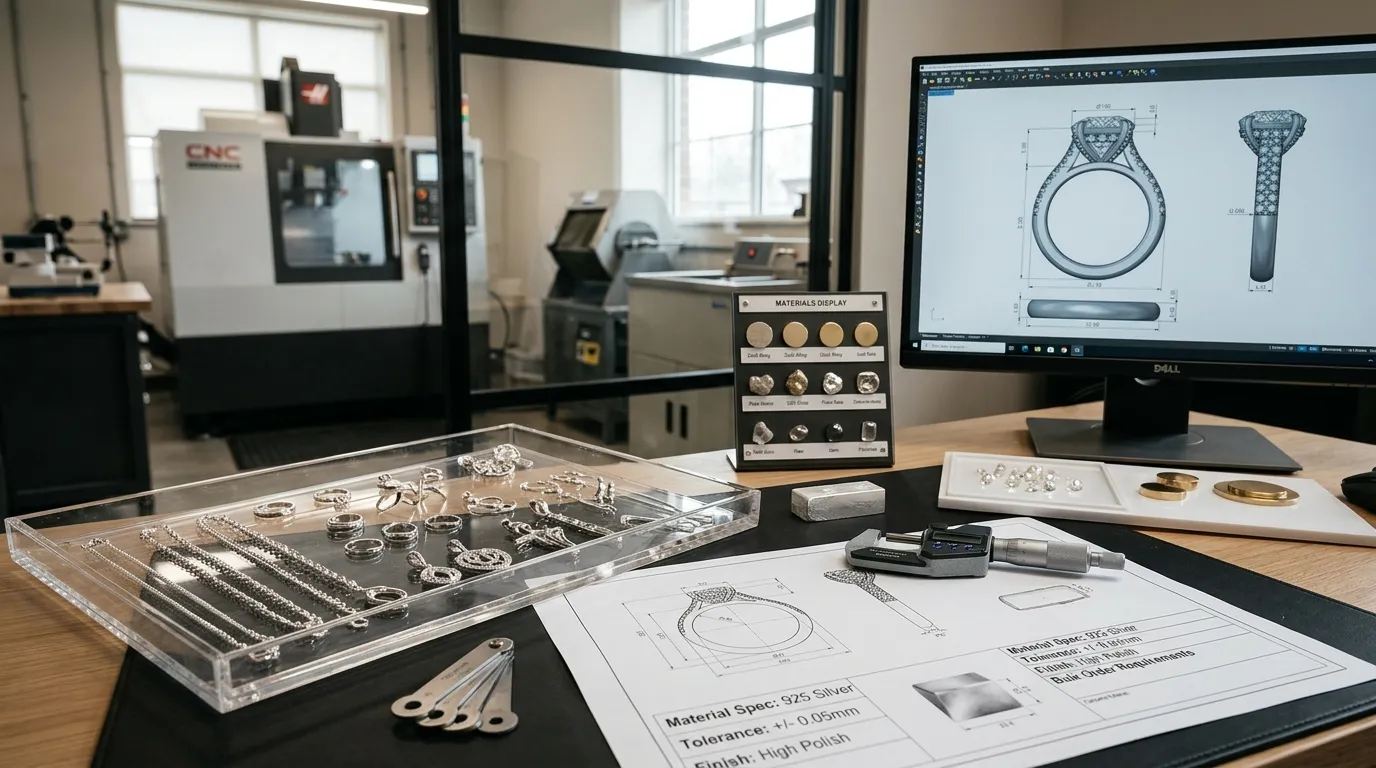
When you send a jewelry design to a manufacturer, the design itself is only part of the production information.
A CAD file can show the shape.
A product image can show the appearance.
But neither necessarily tells us exactly what materials, dimensions, finishes, tolerances, and construction requirements you expect in production.
This becomes a problem when you move from sampling to bulk production.
For example, if your specification only says:
“Brass necklace with gold plating.”
There are still many unanswered questions:
-
Which brass alloy?
-
What plating color?
-
What karat?
-
What plating thickness?
-
What is the base metal thickness?
-
What is the acceptable weight?
-
What chain length?
-
What stone specification?
-
What dimensional tolerance?
-
What finish?
-
What components are included?
Two manufacturers could produce jewelry that looks similar in a product photo but has very different production specifications and costs.
For you as a buyer, a detailed manufacturing order helps establish one clear production target.
At SSJew, we use the manufacturing specification as a reference point between your design, our quotation, sampling, production, and quality inspection.
The more important a specification is to the final product, the more precisely it should be documented.
What Should a Jewelry Manufacturing Order Include?
A useful jewelry manufacturing order should define at least these areas:
-
Base material
-
Material composition or grade
-
Dimensions
-
Weight
-
Plating or coating
-
Surface finish
-
Stones
-
Stone setting
-
Components
-
Tolerances
-
Packaging requirements
-
Quality and testing requirements
You do not necessarily need a complicated technical document for every product.
But you should clearly define the specifications that affect:
cost + appearance + durability + compliance + production consistency.
1. Specify the Base Metal Clearly
The first specification should be the base material.
Avoid descriptions such as:
“Silver color”
“Gold metal”
“High-quality brass”
These describe appearance or marketing positioning rather than a manufacturing specification.
Instead, identify the actual material.
Sterling Silver
If you are ordering sterling silver jewelry, specify:
925 Sterling Silver
This indicates a nominal silver content of 92.5%.
For example:
Base Metal: 925 Sterling Silver
If your product requires a particular alloy or material standard, document that requirement separately.
Brass
“Brass” is not one universal alloy specification.
Different brass compositions can affect:
-
Hardness
-
Machinability
-
Casting performance
-
Color
-
Polishing
-
Plating performance
-
Weight
-
Cost
For a production order, you should therefore avoid simply writing:
Material: Brass
when the alloy specification matters to your product.
Instead, ask your manufacturer to confirm the material specification being used for the production order.
At SSJew, when you provide a brass design, we can review the construction and finishing requirements together rather than treating every brass product as having identical production requirements.
Stainless Steel
If you are developing stainless steel jewelry, specify the required grade where relevant.
For example:
Stainless Steel 316L
is considerably more useful than:
Stainless steel jewelry
The grade can affect material properties and procurement cost, so it should be agreed before production.
2. Define Metal Composition and Compliance Requirements
Material name alone may not be enough for your target market.
If your jewelry will be sold internationally, your manufacturing specification should also identify relevant compliance requirements.
For example:
Requirement
Example
Base metal
925 Sterling Silver
Product market
EU
Chemical compliance
REACH
Lead requirement
Applicable REACH limit
Cadmium requirement
Applicable REACH limit
Nickel requirement
Applicable market requirement
This is particularly important for jewelry containing multiple metal components.
Your specification should not assume that the main body is the only material that matters.
A necklace may contain:
-
Pendant
-
Chain
-
Clasp
-
Jump rings
-
Bail
-
Decorative charms
Each component can introduce a different material requirement.
For example, EU REACH restricts lead in relevant jewelry articles and individual parts at 0.05% by weight (500 ppm) or above, while cadmium is restricted at 0.01% (100 ppm) for relevant jewelry components.
The exact requirement should be confirmed against the regulation applicable to your target market.
3. Specify Plating Thickness and Finish
“18K gold plated” is not a complete plating specification.
This is one of the most common gaps we see in jewelry production orders.
Plating Color
Specify the desired color or finish.
For example:
-
14K yellow gold
-
18K yellow gold
-
Rose gold
-
White gold appearance
-
Rhodium
-
Black
-
Antique gold
-
Antique silver
A reference sample or approved color standard is even better when color consistency matters.
Plating Thickness
If plating durability is important to you, specify the target thickness.
For example:
Gold plating: 0.5 μm minimum
or:
Gold plating: 1.0 μm target
Do not assume that:
“18K gold plated”
automatically defines plating thickness.
Karat describes the gold composition of the plating layer. It does not tell you how thick that layer is.
This distinction matters when you compare quotations from different manufacturers.
Plating Structure
For more demanding jewelry, you may also need to specify the plating system.
For example:
Brass → Nickel-free barrier layer → Gold plating
or another agreed layer structure.
The exact system depends on your material, finish, market requirements, and durability target.
At SSJew, we can review the plating structure with you based on the product's base metal, target appearance, intended use, and required durability.
4. Specify Jewelry Dimensions
Dimensions should be written as measurable specifications rather than estimated descriptions.
For example, instead of:
“Medium pendant”
specify:
Pendant height: 25 mm
Pendant width: 18 mm
Thickness: 2.0 mm
For a necklace:
Chain length: 45 cm
Extension chain: 5 cm
Pendant: 25 × 18 mm
For a ring:
Ring size: US 7
Band width: 3.0 mm
Band thickness: 1.5 mm
The more important a dimension is to fit, appearance, or assembly, the more important it is to define it numerically.
5. Define Production Tolerances
This is where many buyers create problems without realizing it.
You may specify:
Pendant width: 20 mm
But does that mean:
-
20.0 mm exactly?
-
19.8–20.2 mm?
-
19.5–20.5 mm?
Manufacturing always involves some degree of variation.
Your order should therefore define acceptable tolerances for critical dimensions.
Example Jewelry Tolerances
For example, your specification could define:
Specification
Target
Example tolerance
Pendant width
20.0 mm
±0.2 mm
Pendant thickness
2.0 mm
±0.1 mm
Chain length
45 cm
±0.5 cm
Stone diameter
3.0 mm
±0.05 mm
Ring size
US 7
±0.25 size*
*The actual acceptable tolerance should be agreed according to the product and manufacturing process.
Do not copy these tolerances blindly into every product.
The appropriate tolerance depends on:
-
Casting
-
CNC machining
-
Stamping
-
Wire forming
-
Stone setting
-
Plating
-
Assembly
-
Product size
The important point is to define the tolerance rather than leave it completely open to interpretation.
6. Specify Target Jewelry Weight
Weight is particularly important when you are purchasing jewelry by unit cost or developing a consistent collection.
For example:
Target weight: 12.0 g
is much more useful than:
Lightweight design
But weight should normally be treated as a target with an agreed tolerance, rather than an absolute number.
For example:
Target weight: 12.0 g
Acceptable range: 11.5–12.5 g
The correct range depends on your design and manufacturing process.
Why Weight Matters to Your Order Cost
Material weight directly affects material consumption.
If a brass pendant originally quoted at:
15 g
becomes:
20 g
during production, the additional material is not the only issue.
It can also affect:
-
Shipping weight
-
Product feel
-
Chain strength
-
Packaging
-
Retail positioning
-
Unit cost
For larger orders, small differences can become significant.
If your order contains:
5,000 pieces × 5 g additional material
that represents:
25 kg of additional product weight.
This is why weight should be treated as a production specification when it matters to your business.
Specify Stones With Actual Measurements
“CZ stone” or “Moissanite” is not enough information for a manufacturing order.
You should define the stone specification.
Stone Type
Specify:
-
CZ
-
Moissanite
-
Natural gemstone
-
Lab-grown gemstone
-
Synthetic gemstone
-
Glass
-
Other stone type
Stone Size
Use actual measurements.
For example:
Round CZ: 3.0 mm
or:
Emerald-cut stone: 5 × 3 mm
For complex designs, include a stone-setting drawing or CAD file.
Stone Color
For commercial collections, color consistency can matter significantly.
Specify:
-
Clear
-
Champagne
-
Black
-
Blue
-
Pink
-
Custom color
If you require a specific visual appearance, an approved physical sample can be more useful than a simple color name.
Stone Quality
If quality matters to your product positioning, define the expected quality level.
For example, depending on the stone type:
-
Cut
-
Clarity
-
Color
-
Shape
-
Grade
-
Certification requirement
The more expensive the stone, the more important it becomes to document exactly what you are buying.
Specify Stone Setting Requirements
Two pieces can use the same stone but have different setting quality.
Your manufacturing order can specify:
-
Prong setting
-
Bezel setting
-
Channel setting
-
Pavé setting
-
Flush setting
-
Number of prongs
-
Setting depth
-
Stone alignment
-
Required security
For example:
3.0 mm round stones
4-prong setting
Even spacing
No visible stone movement
This gives our production and QC teams a much clearer reference than simply writing:
“CZ setting.”
Define Surface Finish
The same metal can look completely different depending on the surface treatment.
Your order should identify the required finish.
Common options include:
-
High polish
-
Mirror polish
-
Satin
-
Brushed
-
Matte
-
Sandblasted
-
Hammered
-
Antique
-
Textured
For example:
Surface finish: high polish, mirror appearance
is more useful than:
Finish: shiny
If your collection relies heavily on visual consistency, provide an approved reference sample or visual standard.
Specify Edges, Thickness and Structural Details
Some production specifications are not obvious from a front-facing product image.
You may also need to define:
-
Edge radius
-
Wall thickness
-
Minimum metal thickness
-
Hole diameter
-
Bail opening
-
Clasp dimensions
-
Chain gauge
-
Jump ring diameter
-
Solder joints
-
Thread dimensions
For example:
Minimum pendant wall thickness: 1.2 mm
can prevent a manufacturer from interpreting the design too thinly during production.
This is especially important for:
-
Hollow jewelry
-
Large pendants
-
Lightweight designs
-
Fine chains
-
Delicate structures
-
Large cast pieces
Define Component Specifications Separately
If your jewelry contains multiple components, don't put everything under one generic “material” line.
Instead, break it down.
Example Necklace Specification
Main pendant
-
Material: 925 Sterling Silver
-
Size: 30 × 20 mm
-
Thickness: 2.0 mm
-
Finish: High polish
-
Plating: 18K gold
-
Plating thickness: 0.5 μm target
Chain
-
Material: 925 Sterling Silver
-
Length: 45 cm
-
Width: 1.5 mm
-
Finish: 18K gold plated
Clasp
-
Material: 925 Sterling Silver
-
Type: Lobster clasp
-
Size: 8 mm
Stones
-
Type: CZ
-
Shape: Round
-
Size: 2.5 mm
-
Color: Clear
This format dramatically reduces ambiguity.
Include Packaging and Labeling Requirements
Material specifications are not limited to the jewelry itself.
If you are placing a private-label order, you may also need to specify:
-
Jewelry box
-
Pouch
-
Individual OPP bag
-
Barcode
-
SKU
-
Product label
-
Material label
-
Country-of-origin marking
-
Care card
-
Brand logo
-
Packaging dimensions
For example:
Each necklace individually packed in branded pouch
SKU label applied to outer packaging
50 pcs per export carton
These requirements should be included before production rather than added after the jewelry has already been manufactured.