
SSJEW’s Approach to Nickel-Free Jewelry Manufacturing
SSJEW’s Approach to Nickel-Free Jewelry Manufacturing
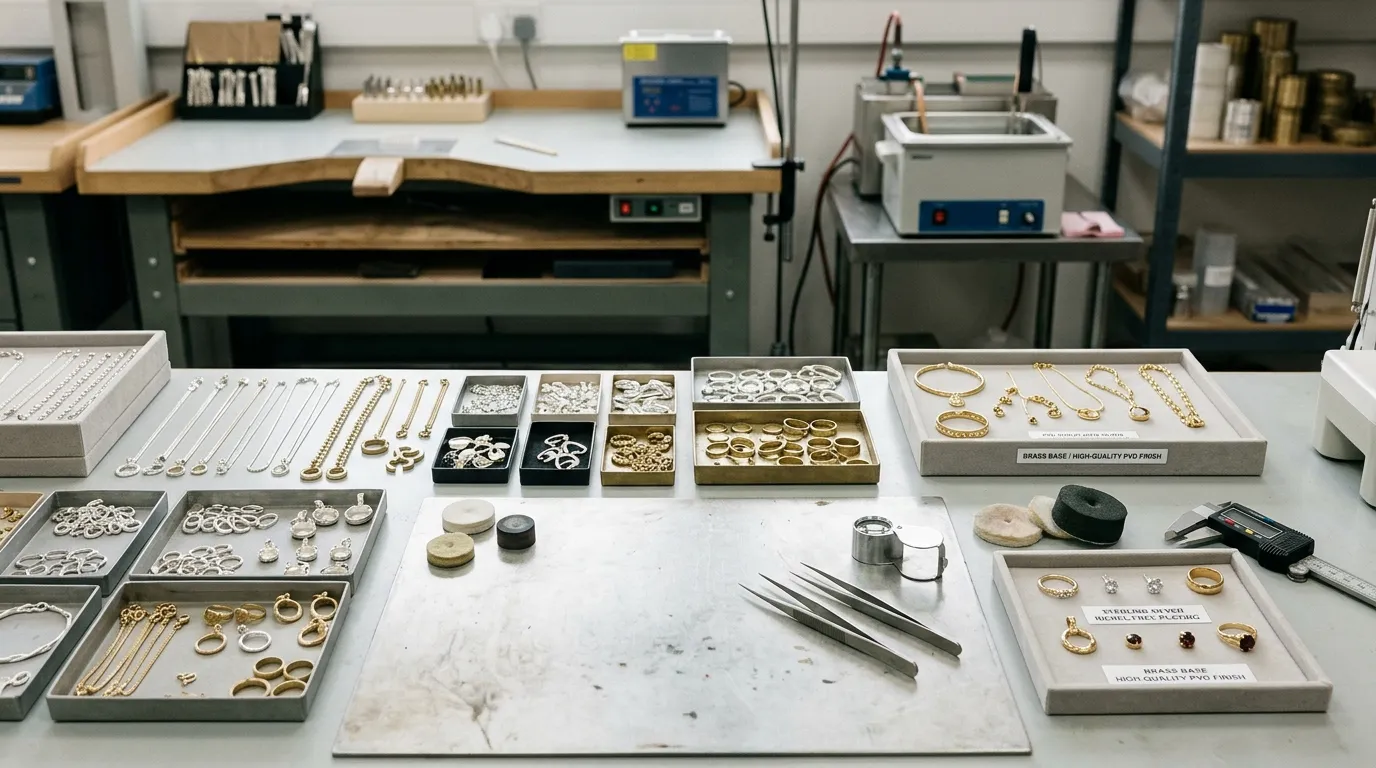
If your jewelry is intended for international retail, nickel requirements are not something you should confirm only after production starts.
For you as a jewelry buyer, “nickel-free” may appear to be a simple product requirement. In manufacturing, however, it can involve the base material, individual components, surface preparation, plating structure, production parameters, and quality control.
At SSJew, we treat nickel requirements as part of the manufacturing specification rather than simply a finishing description. Our production process includes material control, in-house plating, finishing, sampling, and quality inspection, allowing these requirements to be considered across multiple production stages.
What Does Nickel-Free Mean in Jewelry Manufacturing?
The first point to clarify is that nickel-free jewelry and nickel-free plating are not necessarily the same thing.
A jewelry product may contain several different materials and components:
-
Base metal
-
Chain
-
Clasp
-
Jump rings
-
Earring posts
-
Stone-setting components
-
Decorative parts
-
Plating or coating layers
If you only ask whether the final color plating is nickel-free, you may not have defined the requirement for every component.
For products sold in the European market, you may also need to consider nickel release, rather than simply asking whether nickel exists somewhere in the product. Under REACH Annex XVII, certain jewelry articles that have direct and prolonged skin contact are subject to nickel-release limits, including 0.5 μg/cm²/week, while pierced-ear post assemblies have a 0.2 μg/cm²/week migration limit.
The exact requirement depends on your market and product.
For this reason, when you tell us that a product needs to be nickel-free or meet a specific nickel requirement, we need to understand what requirement you are actually trying to meet.
Nickel Control Starts With the Material
Nickel control should begin before plating.
Your jewelry may use 925 sterling silver, brass, gold, stainless steel, or another material. The material specification affects the manufacturing route, finishing process, and the way the surface will respond to subsequent treatment.
Components matter as well.
For example, an item may have a nickel-controlled main body but still contain separate components such as a clasp, chain, spring, post, or connector.
This is why we review material requirements at the project level rather than treating the visible outer surface as the only consideration.
At SSJew, our material system includes defined material specifications, batch-based material management, material traceability, and material checks before production. The purpose is to reduce variation between the approved sample and subsequent production.
If nickel requirements are important to your product, you should therefore provide them at the beginning of the project.
Nickel-Free Plating Is More Than Choosing a Plating Solution
Plating is one of the most important parts of nickel-controlled jewelry manufacturing, but the plating solution itself is only one part of the process.
A typical plating workflow can involve:
Base Material → Surface Preparation → Cleaning → Surface Treatment → Plating Layers → Final Finishing → Inspection
Surface preparation matters because the final coating needs a suitable surface to adhere consistently.
The plating structure also matters.
Depending on the product, your required finish may involve multiple layers or a particular barrier structure before the final color layer. The correct system depends on the base material, desired appearance, durability target, and market requirements.
At SSJew, our manufacturing process includes in-house plating, with nickel-free and lead-free plating options, color and thickness control, and consistent bath and process parameters across production batches.
For you as a buyer, this means the useful question is not simply:
“Do you offer nickel-free plating?”
A better question is:
“How is the nickel requirement controlled from material selection through plating and final inspection?”
That question gives you much more information about the manufacturer's actual production process.
How We Control Nickel Requirements During Production
At SSJew, we connect material control, production, finishing, and QC rather than treating plating as an isolated operation.
The process can be understood in several stages.
1. Requirement Confirmation
Before production, we clarify the required material, finish, plating direction, and relevant quality requirements.
If your product is intended for a particular market, you should tell us that at this stage.
For example, you may require:
-
Nickel-free plating
-
A specific nickel-release requirement
-
REACH-related requirements
-
A particular plating color
-
A defined plating thickness
-
A specific base material
The more precisely you define the requirement, the easier it is to establish an appropriate production reference.
2. Material Control
We then need to ensure that the agreed material specifications are connected to production.
This is particularly important for products containing several metal components.
Your specification should identify which components are subject to the nickel requirement rather than simply stating “nickel-free jewelry” without further clarification.
3. Surface Preparation and Plating
The product moves through the agreed finishing and plating process.
The objective is not only to achieve the correct color. The surface must also be prepared and processed consistently so that the approved finish can be reproduced during bulk production.
4. Quality Inspection
The final product needs to be checked against the agreed production standard.
Our QC process includes incoming material inspection, in-process checkpoints, and final inspection covering areas such as appearance, workmanship, plating, and other defined requirements.
For a nickel-controlled product, your specific testing or documentation requirements should be agreed before production rather than added after shipment.
Nickel-Free Requirements and Color Consistency
One concern you may have is whether changing the plating system will affect the appearance of your jewelry.
This is an important manufacturing consideration.
A gold-tone product, for example, needs more than a general instruction such as “make it gold.”
You may need to establish:
-
Color direction
-
Surface finish
-
Plating system
-
Plating thickness
-
Base material
-
Approved sample
-
Acceptable variation
The approved sample provides a physical reference for appearance.
At SSJew, we use sampling and production references to help maintain consistency from sample to bulk production. Our manufacturing workflow connects CAD, sampling, material control, finishing, and final inspection.
This matters when you reorder the same SKU. A nickel requirement should not be treated as a one-time sample instruction. It should remain part of the production specification for future orders.
Does Nickel-Free Jewelry Cost More?
There is no single additional cost for “nickel-free jewelry.”
The effect on cost depends on your product design, base material, plating system, components, quantity, testing requirements, and other specifications.
For example, cost may be affected by:
-
Material selection
-
Alternative components
-
Plating structure
-
Surface preparation
-
Additional testing
-
Documentation requirements
-
Production quantity
-
Required finish consistency
This is why you should not compare two quotes simply by asking which manufacturer offers “nickel-free plating” at the lower price.
Instead, compare whether both quotations are based on the same:
Material + Components + Plating System + Thickness + Finish + Testing + Quantity + Quality Requirements
If those inputs are different, the prices may not represent the same product specification.
What You Should Confirm With Your Jewelry Manufacturer
Before approving production, we recommend confirming these points with us:
Requirement
What to Confirm
Base material
Exact material or alloy specification
Components
Whether chains, clasps, posts and connectors follow the requirement
Plating
Nickel-free plating system
Nickel requirement
Nickel-free claim or specific nickel-release requirement
Market
Target country or regulatory market
Finish
Color and surface finish
Plating thickness
Required specification where applicable
Testing
Required test method or documentation
Sample
Approved physical reference
Bulk production
How the requirement is carried into production
QC
What is inspected before shipment
If you are unsure which requirement applies to your product, give us your target market and product details first. We can then identify which manufacturing specifications need to be clarified before sampling.
Common Nickel-Free Jewelry Manufacturing Mistakes
Treating “nickel-free” as only a plating instruction
The main body may not be the only source of concern. Components and contact areas also need to be considered.
Not specifying the target market
Different markets can have different regulatory and customer requirements. Tell us where you intend to sell the product.
Assuming a sample proves every future production run
A sample is a reference, not a substitute for controlled production specifications.
Ignoring plating thickness
Color and karat terminology do not by themselves define plating thickness. If thickness matters to your product, specify it separately.
Adding testing requirements after production
If you need specific testing or documentation, communicate it before production so it can be included in the manufacturing plan.