
Custom Jewelry Pricing: What Affects Your Cost Per Piece?
Custom Jewelry Pricing: What Affects Your Cost Per Piece?
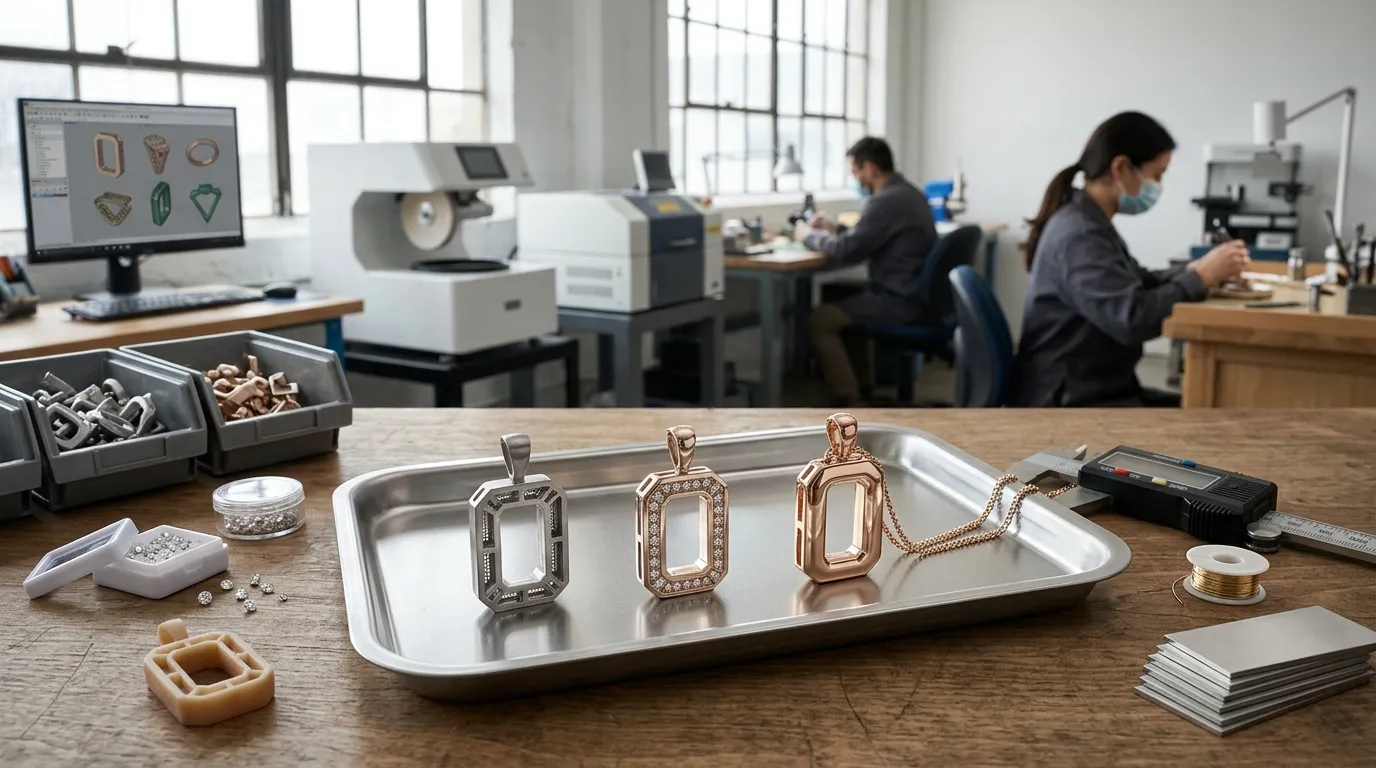
If you are sourcing custom jewelry, the unit price on a factory quotation is only one part of your purchasing decision.
Two manufacturers can quote very different prices for what appears to be the same design because their material specifications, production processes, plating requirements, tooling, labor, and quality controls may be different.
As a jewelry manufacturer, our SSJew approaches pricing from the production side. We look at what your design actually requires, what needs to be controlled during manufacturing, and what must remain consistent when you reorder.
Why Are You Looking for a Jewelry Factory?
You Need More Than a Low Unit Price
When you contact a jewelry factory, you are usually trying to achieve three things: a commercially viable product cost, predictable production quality, and a supplier that can support future orders.
A quotation of $2.00 per piece is not necessarily cheaper than $2.50 if the lower quotation excludes tooling, uses a different material, has a lighter finished weight, or uses a different plating specification.
For B2B jewelry sourcing, the more useful question is not simply:
“What is your price?”
It is:
“What exactly is included in this price?”
The Real Cost Is More Than the Quoted Price
A custom jewelry quotation can contain several cost components:
Cost factor
What affects the cost
Material
Metal type, purity, finished weight
Labor
Number and difficulty of production operations
CAD & development
Design complexity and engineering work
Tooling
Mold, die or other production setup
Plating
Finish, coating specification and surface area
Stone setting
Number, type and setting method
Finishing
Polishing, brushing, engraving and assembly
Packaging
Box, pouch, cards and customized packaging
Quantity
How fixed costs are distributed across units
Industry costing references commonly place metal at roughly 20–60% of unit cost, labor at 15–40%, and plating/coating at 10–35%, although the actual proportion can vary substantially by product and manufacturing route. These are industry reference ranges, not SSJew quotations.
What Affects Your Custom Jewelry Cost Per Piece?
Material and Finished Weight
Material is one of the most obvious cost drivers.
A 925 silver piece, brass piece, stainless-steel piece, and gold piece will have very different material economics. Finished weight also matters because a heavier design generally requires more raw material.
For precious-metal jewelry, the material specification can therefore have a direct impact on your final cost.
Our SSJew team confirms the material direction, design requirements and production specifications before sampling, rather than treating material as an afterthought.
Design Complexity and Production Processes
A simple pendant and a multi-component ring should not be expected to have the same manufacturing cost structure.
Your design may require:
-
CAD and 3D modeling
-
Casting or CNC
-
Multiple components
-
Stone setting
-
Laser or engraving
-
Hand polishing
-
Assembly
-
Multiple finishing processes
The more production operations your design requires, the more labor, setup and quality-control points are involved.
For example, a design with dense pavé setting requires substantially different production control from a smooth, stone-free pendant.
Plating, Finishing and Stone Setting
Plating should not be treated as simply “gold color” or “silver color.”
Your quotation can change depending on the required finish, coating specification, surface preparation, number of finishing stages and surface area.
This is particularly important for plated brass or silver jewelry because surface preparation before plating can directly affect the final appearance and consistency.
Our SSJew production workflow includes polishing, surface refinement, plating and color-consistency checks before final inspection.
For reference, the FTC notes that gold plating eventually wears depending on factors including how the jewelry is worn and the thickness of the plating.
How Should You Evaluate a Jewelry Manufacturer?
Ask What Is Included in the Quote
When comparing factories, ask each supplier to quote against the same specification.
Your RFQ should define:
Material + finished weight + dimensions + plating/finish + stones + packaging + quantity + tooling + quality requirements.
If one supplier gives you a price without explaining these elements, you cannot make a meaningful price comparison.
Our SSJew material and finish workflow is designed around approved material references, finish standards and sample-to-bulk alignment so the quotation and production expectations are connected.
Check the Sample-to-Bulk Process
A factory may produce an attractive sample. The more important question is whether your bulk order can follow the same standard.
Our SSJew workflow uses CAD, physical sampling and approved samples as production references before larger orders move into manufacturing.
How Can You Reduce Jewelry Procurement Risk?
Lock Specifications Before Bulk Production
Before approving bulk production, confirm the:
-
Material
-
Dimensions and weight
-
Plating and finish
-
Stone specification
-
Logo or engraving
-
Packaging
-
Inspection requirements
A clear specification reduces disputes because you and the manufacturer are working from the same production standard.
Use the Approved Sample as Your Production Standard
Your approved sample should not become a forgotten prototype.
At our SSJew factory, materials, workmanship, plating, stone setting and packing are checked against the approved sample through the QC process.
-
QC first-pass rate: 99.85%
-
AQL standard actually used: To be confirmed based on SSJew's current QC SOP
-
Sample-to-bulk defect/rework data: Based on production records
How Do You Build a Long-Term Manufacturing Relationship?
Focus on Repeatability, Not One-Time Pricing
If you plan to reorder successful styles, the cheapest first quotation is not necessarily your most important metric.
You need a supplier that can maintain the agreed material, finish, dimensions and workmanship across future production.
Our SSJew process connects sample approval → production → QC → repeat-order reference, helping you use the approved product standard as the basis for future orders.
-
Countries Served: 120+
-
Customer Satisfaction Rate: 98.71%
-
Monthly Sales Volume: 160000+
For your next RFQ, do not compare factories by unit price alone. Compare what the price includes, how the factory controls production, and whether the same standard can be repeated at scale.
If you already have a design, reference image or specification sheet, our SSJew team can review the manufacturing requirements and build the quotation around the actual production route.