
How Much Does Custom Jewelry Manufacturing Cost?
How Much Does Custom Jewelry Manufacturing Cost?
Gold Plating vs Gold Filled vs Vermeil: Cost and Durability
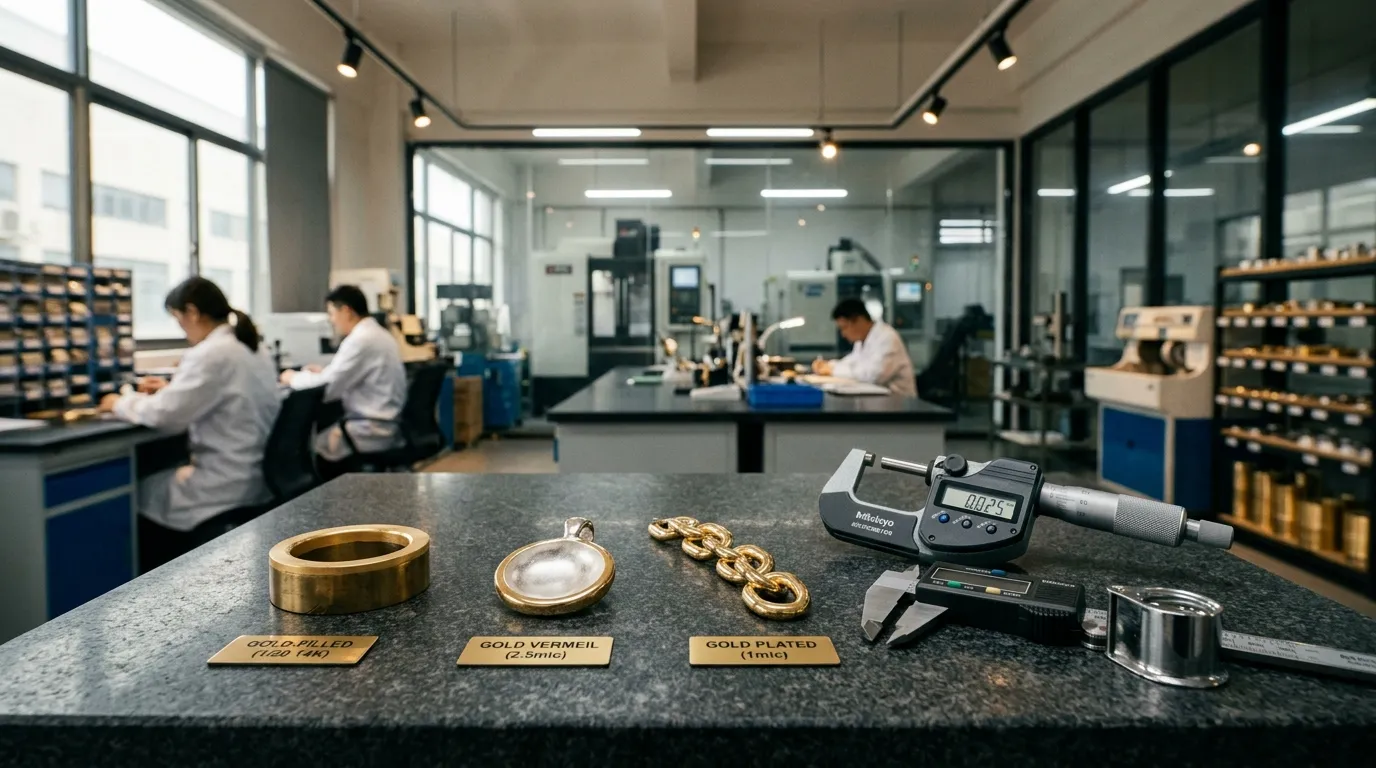
If you are developing a gold-tone jewelry collection, choosing between gold plated, gold filled, and gold vermeil is not simply a question of appearance. The construction you choose affects material cost, durability, product positioning, and what you need to specify to your jewelry manufacturer.
The three options are also different materials and production routes.
Gold plated jewelry uses a layer of gold applied to another metal. Gold filled jewelry uses a mechanically bonded layer of karat gold. Gold vermeil uses sterling silver as the base with a gold coating.
For B2B production, the right choice depends on your target price, product positioning, design, intended use, and required finish standard.
Gold Plated vs Gold Filled vs Vermeil: Key Differences
Factor
Gold Plated
Gold Filled
Gold Vermeil
Base
Various metals
Base metal with bonded gold layer
Sterling silver
Gold application
Surface coating
Mechanical bonding
Gold coating over silver
Material cost
Generally lower
Generally higher
Generally higher than standard plating
Durability
Depends on coating and use
Generally higher than standard plating
Depends on coating and use
Typical use
Cost-sensitive collections
Durability-focused products
Premium silver-based collections
The important point for procurement is that you should not compare suppliers based only on the words “gold plated,” “gold filled,” or “vermeil.” The underlying material and production specification matter.
What Is Gold Plated Jewelry?
Gold plating applies a layer of gold or gold alloy to a base material. Electroplating is a common production method.
For a jewelry manufacturer, the plating process is only one part of the finishing system. Surface preparation, polishing, cleaning, coating application, color control, and final inspection all influence the finished appearance.
This is why gold plating should be treated as a production specification rather than simply a color option.
The FTC notes that gold plating eventually wears away, with the result depending partly on how the jewelry is worn and the thickness of the plating.
If you are developing a collection with multiple custom designs, our custom jewelry manufacturing process connects CAD, sampling, material control, finishing and inspection so the approved design can become a clearer production standard.
When requesting a quote, you should confirm:
-
Base material
-
Gold karat
-
Coating specification
-
Gold color
-
Surface finish
-
Coverage requirements
-
Quality inspection standard
A quotation is much easier to compare when these specifications are defined.
What Is Gold Filled Jewelry?
Gold filled is different from conventional electroplating.
The FTC describes gold filled products as having a layer of at least 10K gold mechanically applied to a base metal. Gold-filled markings can also include a fraction such as 1/20 to indicate the proportion of the article's metal weight represented by the gold layer.
This distinction matters because gold filled is not simply “thicker gold plating.”
The construction itself is different.
Because substantially more gold is involved than in conventional surface plating, gold filled products generally have a higher material cost. For products where durability is an important part of the commercial proposition, that additional material cost may be justified.
However, you should also confirm that your design is suitable for gold-filled construction. The material route needs to work with the product's geometry, forming requirements, components, and final finishing.
What Is Gold Vermeil?
Gold vermeil is a gold-coated product with sterling silver as its base. The FTC specifically describes vermeil as a special type of gold-plated product using sterling silver as the base.
That makes the base material the first major difference between vermeil and ordinary gold plating.
If your product is positioned as a sterling silver collection, vermeil can provide a way to combine a silver foundation with a gold surface finish.
Our custom 925 silver jewelry manufacturing workflow covers silver casting and forming, stone setting, polishing, gold finishing and final inspection.
For your RFQ, you should therefore define both sides of the construction:
Base material: 925 sterling silver
Gold finish: agreed karat, thickness and color specification
Do not treat “vermeil” as a substitute for a complete production specification.
Gold Plating vs Gold Filled vs Vermeil: Cost and Durability
The price difference between these three options does not come from the finish name alone.
Gold content
Gold filled generally contains substantially more gold than conventional plating, which increases material cost.
Vermeil also uses sterling silver as its base, so its material cost can be higher than a plated product using a lower-cost base metal.
Base material
The same design can have very different material costs depending on whether the base is brass, sterling silver, or another metal.
This is why you should compare the complete material route, not just the supplier's unit price.
Surface preparation
A gold finish cannot compensate for poor surface preparation.
Polishing and surface refinement influence how evenly the finished coating appears. Scratches, uneven texture, or poorly prepared areas can remain visible after finishing.
Our jewelry materials and finishes approach focuses on defining the base material and finish direction before sampling, helping reduce differences between the approved sample and later production.
Durability
There is no responsible universal answer such as “this finish lasts two years.”
Actual wear depends on:
-
Coating specification
-
Surface preparation
-
Product geometry
-
Friction
-
Frequency of use
-
Exposure to chemicals and moisture
-
Location of the finished surface
A ring, for example, normally experiences more mechanical contact than a pendant.
For this reason, your manufacturer should evaluate the finish against the actual product rather than promising a generic lifespan.
What Should You Specify to Your Jewelry Manufacturer?
When you send an RFQ, avoid writing only:
“14K gold plated necklace.”
A better production brief should include:
1. Base material
For example, brass or 925 sterling silver.
2. Gold construction
Gold plated, gold filled, vermeil, or another defined route.
3. Gold purity
Specify the required karat where applicable.
4. Coating specification
For plated and vermeil products, define the required thickness according to your product and target market.
5. Color reference
Use an approved physical sample or other agreed reference when color consistency matters.
6. Surface finish
Specify polished, matte, brushed, textured, or another finish.
7. Approved sample
Use the approved sample as the reference for bulk production.
At SSJew, we treat sampling as more than a visual approval step. The sample needs to establish the dimensions, surface appearance, material route and finishing expectations that production can follow.
This is particularly important if you expect repeat orders.
Which One Should You Choose?
The answer depends on your commercial requirements.
Gold plated
Choose this route when cost efficiency and design flexibility are major priorities and the product does not require the construction of gold filled or vermeil.
Gold filled
Consider gold filled when durability and substantial gold content justify the additional material cost and the design is suitable for this construction.
Gold vermeil
Consider vermeil when you want a sterling silver base with a gold finish and the material positioning of the collection supports the additional cost.
If you are developing a higher-value gold collection, our custom gold jewelry manufacturing service can help you review the material route, sample requirements and finishing direction before production.
The most important decision is not which option is universally “best.” It is whether the selected construction matches your target price, product positioning, intended use and production standard.
Common Procurement Mistakes
Comparing different specifications by unit price
A lower quotation may reflect a different base metal, coating specification or finishing requirement.
Treating “gold plated” as a complete specification
You should clarify the base material, gold purity, coating specification and color rather than relying on the finish name alone.
Approving a sample without defining the production standard
Your sample should establish what you expect in bulk production. Otherwise, differences in color, polishing or finishing can become difficult to resolve later.
Asking only about durability
Instead of asking how many years a finish will last, ask how the manufacturer defines the material, coating, surface preparation and inspection requirements for your specific product.