
How to Reduce Custom Jewelry Production Costs Without Cutting Quality
How to Reduce Custom Jewelry Production Costs Without Cutting Quality
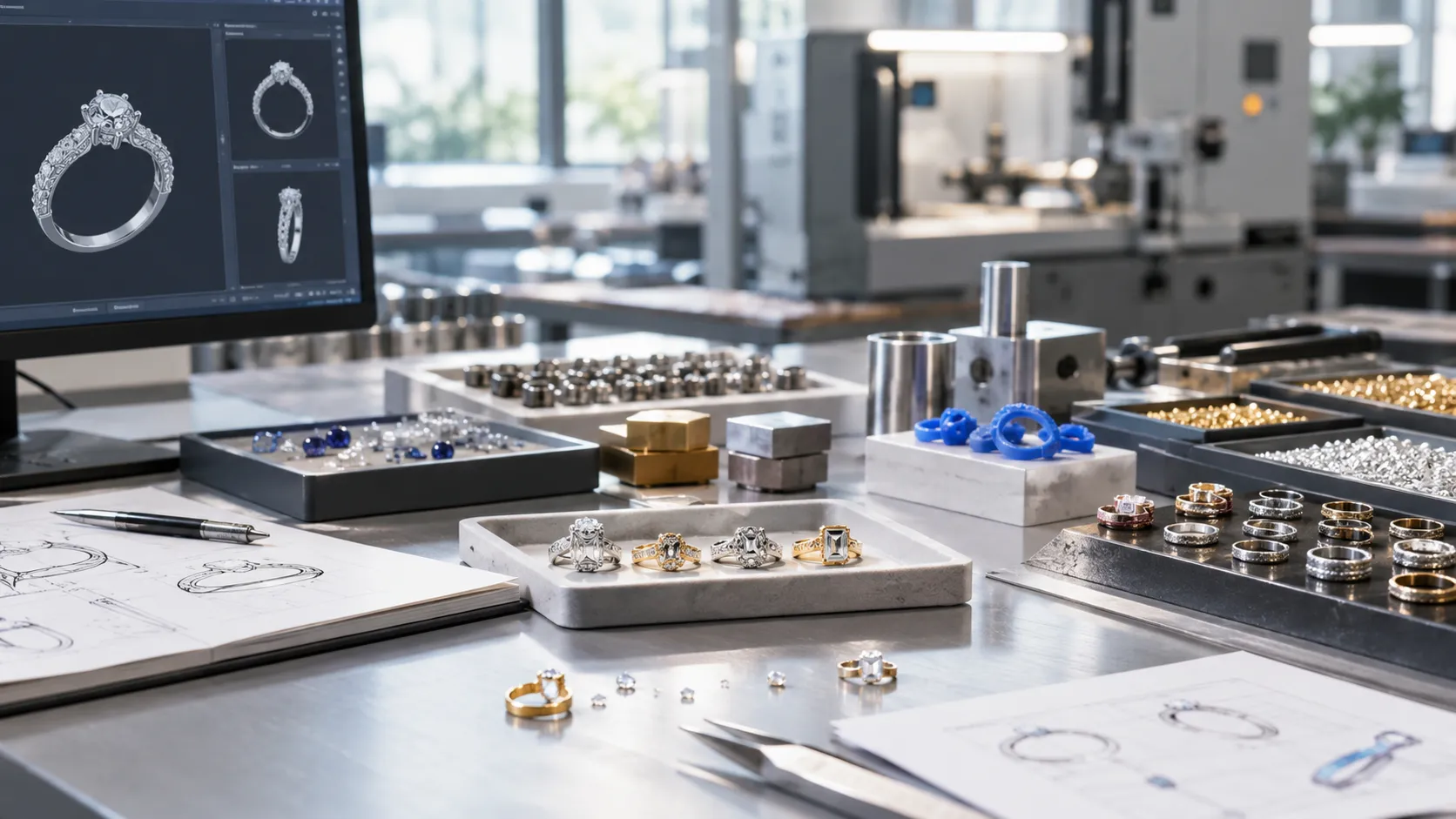
Reducing custom jewelry production costs does not always mean negotiating a lower unit price with your manufacturer.
In many projects, the bigger opportunity is to remove unnecessary manufacturing cost before production starts.
A design may require too many production steps. A piece may use more material than necessary. A manufacturing method may not suit the expected quantity. Packaging may be more complicated than the product requires. Or changes made after sampling may create avoidable development and rework costs.
The goal is not to make every component cheaper.
The goal is to spend money where it affects your product and remove cost where it does not.
At SSJew, we approach custom jewelry manufacturing from this perspective. Our process connects CAD, sampling, material control, finishing and final inspection so production requirements can be reviewed before a design moves into larger-scale manufacturing.
Start With the Design, Not the Factory Price
One of the most effective ways to reduce custom jewelry production costs is to review the design before asking the factory to reduce its quotation.
Remove Unnecessary Complexity
A design can look simple but require multiple manufacturing operations.
For example, a piece may require:
CAD → mold → casting → grinding → polishing → stone setting → plating → assembly → inspection
If one design feature adds another production operation without creating meaningful value for the customer, that feature may be a cost you can remove.
You can ask us to review:
-
unnecessary small components
-
difficult-to-polish areas
-
complicated assembly structures
-
unnecessary engraving
-
excessive stone-setting details
-
difficult-to-machine geometries
The objective is not to make the jewelry look simpler.
It is to make the design easier to manufacture without changing the intended appearance or function.
Optimize Weight Without Weakening the Design
Material weight is another important cost factor, particularly for silver and gold jewelry.
Reducing weight can lower material cost, but making a component unnecessarily thin can create structural or production problems.
Instead of simply asking for “less metal,” you can ask your manufacturer to review:
-
wall thickness
-
hollow versus solid construction
-
structural support
-
connection points
-
stone-setting areas
-
wearable components
-
areas that do not need full material thickness
At SSJew, our CAD process includes reviewing dimensions, wall thickness, stone seats and structural details before sampling.
That makes CAD more than a visualization step. It can become an early cost and manufacturability review.
Choose Materials Based on the Product's Requirements
Material selection should match your product positioning, target price and required performance.
For example, a design intended for a fashion jewelry collection may have different material requirements from a premium sterling silver collection.
You should compare:
-
material cost
-
target product price
-
expected wear
-
required finish
-
product weight
-
plating requirements
-
structural requirements
-
customer positioning
The lowest-cost material is not automatically the right choice.
A cheaper base material that requires additional processing, more complicated finishing or a different production route may not produce the lowest total manufacturing cost.
For plated brass jewelry, for example, you should consider the relationship between the brass construction, surface preparation, plating and final appearance rather than evaluating the base metal price alone.
Our brass manufacturing workflow uses sampling to review scale, surface details and manufacturability before larger production, while the approved sample can then become a reference for bulk production and future reorders.
Choose the Right Manufacturing Process
Different manufacturing processes create different cost structures.
Depending on your design and expected quantity, production may involve casting, stamping, CNC machining, polishing, stone setting or assembly.
Casting vs. Stamping vs. CNC
You do not necessarily want the cheapest process.
You want the process that fits the design and production quantity.
For example:
Manufacturing Route
Useful When
Cost Consideration
Casting
Complex 3D shapes and repeat production
Tooling and finishing
Stamping
Suitable flat or formed components at volume
Tooling but efficient production
CNC
Complex or precise components, smaller runs
Machine time and setup
Hand finishing
Detailed surface work
Labor time
Stone setting
Gemstone or CZ designs
Setting labor and inspection
A recent manufacturing cost analysis similarly identifies material, labor, plating, finishing and packaging as major components of a custom jewelry unit cost, while tooling is generally treated as a separate one-time cost. These figures vary by product and supplier, so they should be used as a cost-structure reference rather than as a quotation.
Reduce Unnecessary Production Steps
If your product can achieve the required appearance with fewer operations, you may reduce both labor and production risk.
This is why you should involve the manufacturer early rather than finalizing every technical detail before discussing manufacturability.
At SSJew, our workflow moves from production-ready CAD and sampling into molding/casting or CNC depending on the product architecture.
Optimize Tooling, Sampling and Development Costs
Tooling and sampling are often treated as costs to minimize.
A better approach is to treat them as development costs that can prevent larger production costs later.
Fix Problems Before Bulk Production
A physical sample can reveal problems that are difficult to identify from a rendering:
-
incorrect proportions
-
weak structural areas
-
stone-setting problems
-
unsuitable surface finish
-
uncomfortable dimensions
-
plating expectations that are difficult to reproduce
-
assembly issues
SSJew's sampling process is specifically positioned as a stage for checking fit, finish and manufacturability before larger orders.
This can reduce the risk of discovering an expensive design problem after bulk production has already started.
Separate One-Time and Recurring Costs
When reviewing a quotation, separate:
One-time costs
-
CAD
-
Prototype
-
Mold
-
Tooling
-
Initial development
from:
Recurring costs
-
Material
-
Labor
-
Plating
-
Stone setting
-
Finishing
-
Assembly
-
QC
-
Packaging
This makes it easier to understand where you can actually reduce the long-term unit cost.
Use MOQ and Quantity Strategically
Production quantity affects unit economics because some manufacturing costs are fixed for a production run.
Tooling, setup, production preparation and certain batch processes can be distributed across more units as quantity increases.
However, ordering more is not automatically better.
If you order 5,000 pieces simply to obtain a lower unit price but can only sell 1,000, your total inventory cost may be higher.
Instead, compare several production quantities:
100 pcs → 300 pcs → 500 pcs → 1,000 pcs
Ask your manufacturer how the unit cost changes at each quantity.
Also confirm whether MOQ applies per:
-
order
-
style
-
color
-
size
-
plating finish
-
material
This is important because a quoted MOQ may look reasonable until you multiply it across several product variations.
Optimize Plating, Finishing and Packaging
You should specify the finish you actually need rather than automatically selecting the most expensive specification.
For example, clarify:
-
plating color
-
gold karat
-
plating thickness where required
-
surface preparation
-
polishing level
-
texture
-
PVD or electroplating
-
final appearance standard
Do not remove a plating or finishing requirement that protects the product's intended appearance simply to reduce the quotation.
Instead, remove specifications that do not create meaningful value for your product.
Packaging is another area worth reviewing.
Ask whether you really need:
-
custom rigid boxes
-
multiple inserts
-
special printed materials
-
individual bags
-
complex labels
-
multiple packaging layers
If your customer experience does not depend on a particular packaging feature, simplifying it may reduce cost without changing the jewelry itself.
Do Not Cut QC to Save Money
Quality control is sometimes viewed as an additional production expense.
For a B2B jewelry brand, it can also be a cost-control mechanism.
If defects are discovered after shipment, your real cost may include:
inspection → sorting → rework → replacement → shipping → customer service → delayed delivery
That can exceed the cost of identifying the problem during production.
At SSJew, our stated QC workflow includes incoming QC, inline QC and final inspection, with checks covering materials, workmanship, plating, stone setting and packing against the approved sample.
Your exact QC requirements should still be confirmed for each project:
QC inspection items: Material, Dimensions, Weight, Appearance, Plating, Stone Setting, Function, Packaging
AQL standard: ISO 2859-1 / ANSI/ASQ Z1.4
Final inspection ratio: 100%
Rework rate: ≤2%
The key principle is simple:
Do not save US$0.10 in QC and create US$1.00 of avoidable production problems.
Build for Repeat Orders
The first production order is not necessarily the most important cost calculation.
If you plan to reorder a successful style, you should consider how easily the product can be reproduced with the same:
-
dimensions
-
weight
-
material
-
plating color
-
surface finish
-
stone placement
-
logo position
-
packaging
An approved sample can become the reference for future production.
SSJew's current manufacturing and brass production information specifically describes approved samples as references for bulk production and future reorders.
This matters because repeat-order inconsistency can create hidden costs even when the original unit price looks attractive.
A Practical Cost-Reduction Checklist
Before asking us or another manufacturer to reduce your quotation, review these questions:
Cost Area
Question to Ask
Design
Can unnecessary production steps be removed?
Weight
Can material be optimized without weakening the structure?
Material
Is the material appropriate for your target positioning?
Process
Is casting, stamping or CNC the right route?
Tooling
Is the tooling necessary for your expected quantity?
Sampling
Can design problems be solved before bulk production?
MOQ
Is the MOQ appropriate for your sales volume?
Plating
Are you paying for specifications you do not need?
Finishing
Which surface treatments actually affect the product?
Packaging
Can packaging be simplified without affecting your brand experience?
QC
Which inspections are necessary to protect your quality standard?
Reorders
Can the approved sample become the production reference?
This approach gives you a better cost-reduction strategy than simply asking:
“Can you give me a lower price?”
Instead, ask:
“Which parts of this production specification can we optimize without changing the quality standard?”
That question gives your manufacturer something concrete to work on.