
Jewelry Plating Cost: What B2B Buyers Should Know
Jewelry Plating Cost: What B2B Buyers Should Know
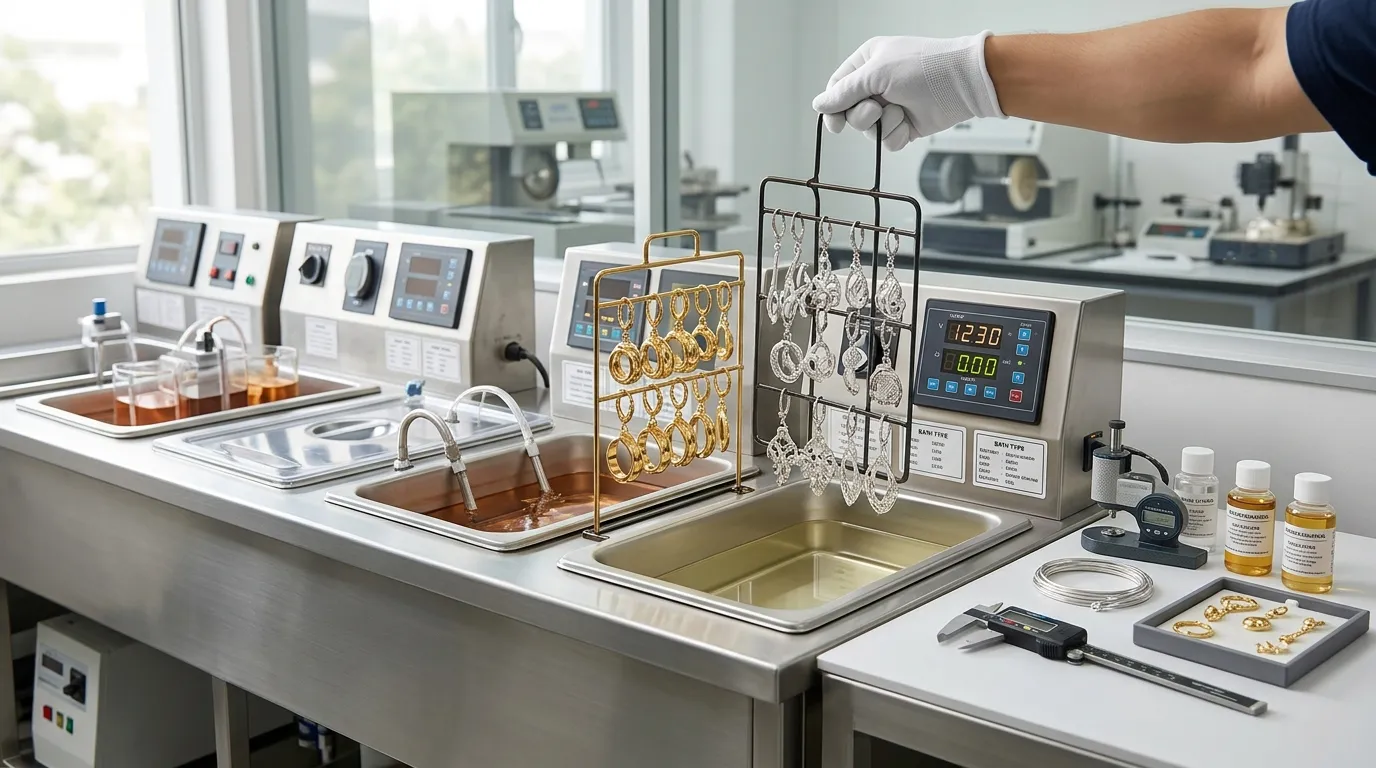
If you are sourcing plated jewelry, “gold plated” is not a complete manufacturing specification.
Your plating cost can change according to the coating thickness, base metal, surface preparation, plating metal, design geometry, surface area, quantity and quality-control requirements.
At our SSJew, we look at plating as part of the manufacturing process, not simply the final color applied to a finished product.
Why Does Jewelry Plating Affect Your Manufacturing Cost?
You Are Paying for a Plating Specification, Not Just a Color
When you request “18K gold plating,” you have defined the gold color and karat, but not necessarily the complete production specification.
Your manufacturer may still need to know:
Base Metal + Gold Karat + Micron Thickness + Surface Finish + Barrier Layer + Color Reference
For example, public industry references commonly place standard gold plating around 0.5–1.0 μm, while heavier plating can reach 2.5 μm or more. These are reference ranges rather than universal requirements.
The FTC also distinguishes specific terms such as “gold electroplate” and “vermeil” under U.S. jewelry guidance, showing why coating construction and thickness matter when making material claims.
The Same Gold Color Can Have Different Costs
Two products can both look like 18K yellow gold but use different coating thicknesses and production processes.
If one specification requires 0.5 μm and another requires 2.0 μm, the amount of deposited gold is not the same.
The cost can therefore change even when the visual color appears similar.
What Determines Jewelry Plating Cost?
Plating Thickness in Microns
Micron thickness is one of the most important variables in plating cost.
A simplified way to understand it is:
More Surface Area × Greater Coating Thickness = More Plating Material
For B2B sourcing, public references commonly show approximately:
-
0.05–0.5 μm: flash/light plating
-
0.5–1.0 μm: standard gold plating
-
2.5 μm+: heavy plating / common vermeil reference
Actual performance depends on the base material, preparation, geometry, wear conditions and plating system.
The FTC notes that gold plating eventually wears depending on how the jewelry is worn and the thickness of the plating.
-
SSJew 0.5 μm Actual Plating Cost: Benchmark: USD 0.30–0.80 per piece
-
SSJew 1.0 μm Actual Plating Cost: Benchmark: USD 0.50–1.20 per piece
-
SSJew 2.0 μm Actual Plating Cost: Benchmark: USD 0.90–2.00 per piece
-
SSJew 3.0 μm Actual Plating Cost: Benchmark: USD 1.30–3.00 per piece
Base Metal and Surface Preparation
Plating does not start with the plating bath.
The base metal must first be prepared so the final coating can achieve the required appearance and adhesion.
Your production route may include:
Polishing → Cleaning → Surface Preparation → Barrier Layer → Gold/Rhodium Plating → Final Inspection
A poorly prepared surface can create problems that become visible after plating.
Our SSJew workflow connects polishing, surface preparation, plating and finish control, helping us evaluate the base material and final finish as one manufacturing process.
Plating Type and Metal Value
Gold, rhodium and other plating systems have different material and processing economics.
One public B2B reference uses standard gold plating as a 1.0× cost baseline, with rhodium around 1.3–1.5×, heavy gold around 1.5–2.0×, and vermeil around 2.0–3.0×. These are third-party market references, not SSJew quotations.
For your quotation, you should therefore compare the actual plating specification rather than simply asking which finish is cheaper.
Jewelry Design and Surface Area
A large pendant and a small stud may use the same plating color, but they do not necessarily require the same amount of plating work.
Your cost can be affected by:
-
Total surface area
-
Number of components
-
Recessed areas
-
Edges and corners
-
Selective plating
-
Masking requirements
-
Multiple colors on one piece
Complex designs can therefore increase both plating preparation and inspection requirements.
Order Quantity and Production Setup
Plating also has setup and handling costs.
For a larger B2B production run, fixed preparation and setup costs can be distributed across more pieces.
For example, if a $300 setup cost is allocated across:
-
100 pieces = $3.00 per piece
-
1,000 pieces = $0.30 per piece
-
5,000 pieces = $0.06 per piece
This is why you should compare plating quotations using the same order quantity.
How Should You Evaluate a Jewelry Plating Quote?
Compare the Same Plating Specification
When you request quotations, define:
Base Metal + Karat + Microns + Color + Surface Finish + Quantity
Without these specifications, two factory quotations may not represent the same product.
Ask What Layers Are Included
Ask whether the quoted plating includes:
-
Surface preparation
-
Barrier layer
-
Main plating
-
Protective topcoat, if applicable
-
Polishing
-
Masking
-
Final inspection
This helps you identify why one quotation may be higher.
At our SSJew, plating is integrated with our broader manufacturing workflow, including material control, surface finishing and final inspection.
Check How Plating Thickness Is Verified
Visual inspection can confirm color and surface appearance, but it cannot reliably tell you the exact micron thickness.
For projects where coating thickness is commercially important, ask how the manufacturer verifies the specification.
Methods used in the jewelry industry include XRF measurement, coulometric testing and cross-section analysis.
-
XRF Testing: Available for material composition and precious-metal content verification
-
Internal Plating Thickness Measurement: Available for plating thickness verification, with target thickness specified according to product requirements
-
Third-Party Testing: Available upon request through qualified independent testing laboratories
How Can You Reduce Plating-Related Procurement Risk?
Approve a Physical Finish Sample
Before bulk production, approve a physical sample that defines:
Color + Surface Finish + Plating Thickness + Base Material
A digital image is not enough to establish a production finish because screen color does not represent actual metal color or surface texture.
Our SSJew process uses sampling and finish control before bulk production, allowing the physical sample to become the manufacturing reference.
Define the Plating Specification Before Bulk Production
Avoid specifications such as:
“18K gold plated.”
Instead, your production specification should be detailed enough for the factory and your QC team to evaluate the same requirement.
-
Actual Plating Pass Rate: ≥98%
-
Plating-Related Rework Rate: ≤2%
-
Average Plating Lead Time: 2–5 business days
How Do You Build Consistent Plating for Repeat Orders?
Standardize the Approved Finish
If your jewelry collection will be reordered, the first approved sample should become a repeat-production reference.
At our SSJew, we connect material control → polishing → plating → finish inspection → QC → repeat production.
Our published manufacturing information includes 200+ active craftsmen and more than 500,000 pieces of monthly production capacity, supporting larger B2B production programs.
The objective is not simply to find the cheapest plating option.
It is to define a plating specification that fits your target cost, product positioning, expected wear, appearance requirements and repeat-order standard.
For your next RFQ, give your manufacturer the base metal, karat, micron requirement, finish reference and quantity. The more specific your plating requirement is, the more meaningful your factory quotation will be.